 |
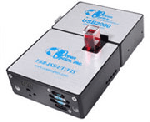
CHEMUSB4-UV-VIS Spectrometer, Low cost spectrometer
- The CHEMUSB4-UV-VIS is the perfect marriage of our USB-interface spectrometer technology and modular accessories. The system consists of a USB4000 Spectrometer with a combination deuterium tungsten halogen light source and 1-cm cuvette holder and high-speed electronics and operating software.
- The CHEMUSB4-UV-VIS covers the 200-850 nm range, has optical resolution of 1.0 nm (FWHM) and captures 3648 wavelengths in <1 second.
- Fully integrated, preconfigured system covers the 200-850 nm range at 1.0 nm (FWHM)
- Small-footprint system ideal for the laboratory and the classroom
- Direct-attach deuterium tungsten light source and sample holder
- 10 µs integration time
- USB 2.0 interface for fast, hassle-free spectrometer-to-PC connection.
- Serial port operation tips: When using the serial port, the USB4000 requires a single 5-volt power supply (not included). Also, SpectraSuite Spectroscopy Software does not support spectrometer operation via the serial port. However, using the included Serial Port Command Set, you can write your own software that makes serial port operation possible.
General specifications
- Spectrometer dimensions: 89.1 mm x 63.3 mm x 34.4 mm
- Spectrometer weight: 190 g
- Light source dimensions: 198 x 105.1 x 40.6 mm
- Light source weight: 200 g
- Power consumption: 250 mA @ 5 VDC
- Data transfer speed: Full scans to memory every 4 ms with USB 2.0 port, 18 ms with USB 1.1 port
- Connector: 22-pin connector
- Computer interfaces: USB 2.0 @ 480 Mbps (USB1.1 compatible); RS-232 (2-wire) @ 115.2 K baud
- Operating systems: Windows 98/Me/2000/XP, Mac OS X and Linux with USB port; Any 32-bit Windows OS with serial port.
Detector Specifications
- Detector: Toshiba TCD1304AP Linear CCD array
- Detector range: 200-1100 nm (the CHEMUSB4-UV-VIS is preconfigured to cover the 200-850 nm range)
- Pixels: 3648 pixels
- Pixel size: 8 micrometer x 200 micrometer
- Pixel well depth: 100,000 electrons
- Signal-to-noise ratio: 300:1 (at full signal)
- A/D resolution: 16 bit
- Dark noise: 12 RMS counts
- Corrected linearity: >99.8%
- Sensitivity: 130 photons/count at 400 nm; 60 photons/count at 600 nm
- Fiber optic connector: SMA 905 to 0.22 numerical aperture single-strand optical fiber
- Optical resolution: 1.0 nm FWHM
- Integration time: 3 µs to 65 seconds
- Dynamic range: 2 x 10⁸ (system), 1300:1 for a single acquisition
- Power consumption: 1.8 A @ 5 VDC; external power supply (included)
- Pathlength: 1 cm
- Cuvette shape: Square
Source Specifications
- Light source: Deuterium tungsten
- "Z" dimension: 15 mm
- Bulb life (hours): 800 deuterium; 2,000 tungsten
- Time to stabilized output: ~30 minutes
|
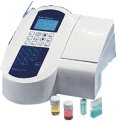 |
Spectrophotometer for water and waste water testing
TheSpectroDirect is a modern single-beam spectrophotometer with an excellent price/performance ratio that is specifically designed for water testing. The instrument is equipped with a wide range of pre-programmed methods based on the proven range of Lovibond® tube tests, tablet reagents, liquid reagents and powder reagents (Vario Powder Packs).
- Wavelength range from 330 to 900 nm
- Interface RS232
- Large illuminated graphic display
- Touch-sensitive film keypad with logical layout
- Use of round vials and rectangular cells of different sizes without adapter
- Fast, easy lamp change
- Software updates free of charge
TheSpectroDirect is a single-beam spectral photometer (see illustration). The light source is a tungsten halogen lamp with flash function. The lamp is switched on only momentarily during of the measurement process1), so there is no need for a warm-up period.
On the back of the SpectroDirect photometer, there is an RS232 interface with a 9-pin D-Sub connector for connection of a PC or a printer with serial interface (see accessories).
A wavelength scan is performed over the user-defined interval between 330 and 900 nm. The display shows the graph of the spectrum; if the user presses a key, the display also shows a data list with the corresponding maximum and minimum absorption levels.
|
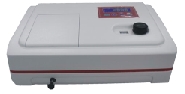 |
Visible Spectrophotometer AE-S50
Visible spectrophotometer with highly stable optics.
USB port for data storage.
PC software available.
Extensive range of accessories available.
1200 line grating which ensures high resolution, low stray light and high parameters accuracy.
Four display mode: Absorption, transmittance, concentration and coefficient directly by different mode switching.
Technical specifications
- Wavelength Range 325-1000 nm
- Band Width 4 nm
- Wavelength Accuracy ±2 nm
- Wavelength Repeatability 1nm
- Photometric Accuracy ±0.5%T
- Photometric Repeatability 0.3%T
- Stability 0.002A/h @ 500nm
- Stray Light 0.3%T@220nm, 360nm
- Printer Port Parallel Port
- Display LED Display
- Lamp Tungsten Halogen Lamp
- Detector Silicon Photodiode
- Packing Size & Weight 550×420×280mm & 8kg
|
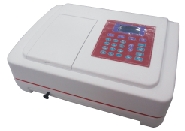 |
UV VIS Spectrophotometer AE-S60
Single beam spectrophotometer with highly stable optics.
UV range 190-1000nm & VIS range: 325-1000nm.
Spectral bandwidth 4nm.
USB port for data storage.
PC software available.
Extensive range of accessories available.
Technical specifications
- Wavelength Range: 190-1000nm
- Band Width 4nm
- Wavelength Accuracy ±1nm
- Wavelength Repeatability 0.5nm
- Photometric Accuracy ±0.5%T
- Photometric Repeatability 0.3%T
- Photometric Display Range 0-200%T, -0.3-3.0A, 0-9999C
- Stability 0.002A/h @ 500nm
- Stray Light 0.3%T@220nm, 360nm
- Data Output Port USB
- Printer Port Parallel Port
- Optical System Single Beam (1200 lines/mm grating)
- Display 128x64 Dots LCD
- Detector Silicon Photodiode
- Software UV or VIS software
- Packing Size & Weight 550×420×280mm & 14kg
|
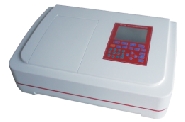 |
UV VIS Spectrophotometer AE-S80
Single beam spectrophotometer with highly stable optics.
Variable spectral bandwidth 0.5, 1, 2, 4,5 nm.
2 or 8 cell holder available.
6 inches LCD display & integrated user interface.
USB port for data storage.
PC software included as standard.
Extensive range of accessories available.
For quantitative analyses, kinetics, wavelength scanning, multiple components and DNA/Protein
analysis,etc.
Technical specifications
- Wavelength Range 190-1100 nm
- Wavelength Accuracy ±0.3 nm
- Wavelength Repeatability 0.2 nm
- Band Width 1nm/1.8 nm/0.5,1,2,4,5 nm
- Photometric Accuracy ±0.3%T
- Photometric Repeatability 0.2%T
- Photometric Display Range 0-200%T, -0.3-3.0A, 0-9999C
- Stability 0.002A/h @ 500 nm
- Baseline Flatness ±0.001A
- Noise ±0.001A
- Stray Light 0.05%T @220nm, 360nm
- Optical System Single Beam (1200 lines/mm grating)
- Display LCD (320X240 Dots)
- Detector Silicon Photodiode
- Lamps Deuterium & Tungsten Halogen Lamp
- Power Supply AC 220V/50Hz, 110V/60Hz
- Packing Size & Weight 860x660x465mm & 35kg
|
|
Dual beam UV VIS Spectrophotometer AE-S90
Double beam spectrophotometer with highly stable optics.
Variable spectral bandwidth 0.5, 1, 2, 4,5nm.
2 or 8 cell holder available.
6 inches LCD display & integrated user interface.
USB port for data storage.
PC software included as standard.
Extensive range of accessories available.
ideal for quality control, general research, pharmaceutical, biochemical and clinical laboratory applications
Technical specifications
- Wavelength Range 190-1100 nm
- Wavelength Accuracy ±0.3 nm
- Wavelength Repeatability 0.2 nm
- Bandwith 1nm/1.8nm/0.5,1,2,4,5 nm
- Accuracy ±0.3%T
- Photometric Repeatability 0.2%T
- Photometric Display Range -0.3-3A,0-200%T,0-9999C
- Stability ± 0.001A/h @ 500 nm
- Baseline Flatness ±0.001 A
- Noise ±0.001 A
- Optical System Double Beam (1200 lines/mm grating)
- Display LCD (320x240 Dots )
- Lamps Deuterium & Tungsten Halogen Lamp
- Detector Silicon Photodiode
- Power Supply AC 220V/50Hz, 110V/60Hz.
- Packing Size & Weight 860x660x465mm & 35kg
- scanning speed : 800nm/min, 1000nm/min, 1200nm/min
|
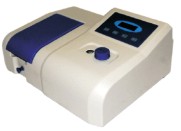 |
Visible Single Beam Spectrophotometer LI 721 low cost
monochromator with holographic flashing grating. It has the advantage of high wavelength precision, good monochromaticity and low stray light.
sample compartment for 0.5 cm-10 cm cells
direct concentration read-out and concentration factor setting function.
Technical Specifications
- Wavelength Range: 340 - 1000 nm
- Transmittance Range: 0 - 199.9
- Absorbance Range : 0 - 1.999
- Range for concentration display: 0 - 1999
- Wavelength Accuracy: ±3 nm
- Wavelength Repeatability: 1.5 nm
- Transmittance Accuracy: ±1%
- Absorbance Repeatability: 0.3%
- Bandwidth: 2nm
- Stray Light: 1.0%
- Overall Dimensions: 460 x 350 x 180
- Weight: 8 kg
- Display: LCD Screen with backlight
- Output ModeStandard RS232 serial port
|
|
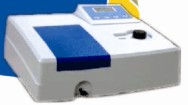
Visible Single Beam Spectrophotometer LI 722
monochromator with a holographic flashing grating. It has the advantage of high wavelength precision, good monochromaticity and low stray light.
automatic switching of tungsten halogen lamp and deuterium lamp.
sample compartment for 0.5 cm-10 cm cells.
computer control system
automatic zero and full scale adjustment.
direct concentration read-out and concentration factor setting function.
equipped with RS232 port. Printer can be connected and data can be sent to PC by special software.
Technical Specifications
- Wavelength Range 325 - 1000 nm
- Wavelength Accuracy < 2nm
- Wavelength Repeatability <1nm
- Transmittance Accuracy ±0.5%
- Transmittance Repeatability <0.2%
- Spectrum Bandwidth 2nm
- Stray Light <0.5% (at 360nm, NaN02
- Light Current Drift 0.5% / 3 min
- Dark Current Drift 0.2% / 3 min
- Cell Holder Dimensions 10 mm
- Weight: 14 kg
|
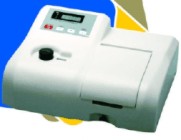 |
UV-Visible Single Beam Spectrophotometer I 290
covers 195 to 1000 nm
high wavelength precision
deuterium lamp and tungsten lamp
sample chamber can be placed 5 mm~l00 mm samples
Rs232, can be connected to the computer and printer
Technical Specifications
- Photometric Range: 0 bis 200% transmission ,-0.301 bis 2.000A, 0 bis 1999 Concentration
- Accuracy: ± 0.005 Abs at 1.0 Abs, ±0.010 Abs at 1.5Abs
- Stray Light< 0.3%T at 220nm and 360nm
- Readability± 1 Count
- Key Board: 4 Keys, Soft touch membrane type
- Printer interface for any Centronics dot matrix printer
- RS 232C interface
- Light Source: halogen, deuterium lamp (2000h)
- Detector: wide range Silicon Photodiode
- Optics: Complete mirror optics with resolution 1200 grooves/mm grating
- Sample Holder4 position adjustable sample holder
- Absorbance Measurement Range: 0.000A-1.999 A
- Software included
|
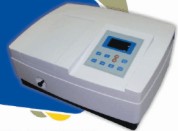 |
UV-Visible Single Beam Spectrophotometer LI 295
Large LCD Screen
Can display and save 50 groups of data, 5 groups per screen.
Tungsten lamp and deuterium lamp can be turned on/off individually to extend lifetime
With Wave length Scan Software
Technical Specifications
- Wavelength Range: 190-1000 nm
- Spectral Bandwidth: 2 nm
- Optical System: Single Beam, Grating 1200 lines/ mm
- Wavelength Accuracy: ± 1 nm
- Wavelength Repeatability: 0.3% T
- Wavelength Setting: Auto
- Photometric Accuracy: ± 0.5% T
- Photometric Repeatability: 0.3% T
- Photometric Range: -0.3-3A, 0-200% T
- Stray Light: 0.3% T
- Stability: <0.002A/h (at 500 nm, after warming up)
- Detector: Silicon photodiode
- Display: 128*64 dots LCD
- Standard Cell Holder: 4-position, 10mm cell changer
- Light Source: tungsten and deuterium lamp
- Output: USB Port & Parallel port (printer)
- Power Requirements: AC 85- 250V
- Dimensions: 420 x 280 x 180 mm
- Weight: 12 kg
|
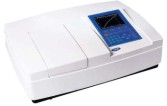 |
UV-Vis Double Beam Spectrophotometer LI-2800
Model LI-2800 with single cell cuvettes holder Model LI-2802 with 8 cell cuvettes holder
Technical Specifications
- Optical SystemDouble Beam (1200 Lines/mm Grating)
- Wavelength Range:190-1100 nm
- ModeBasic/Quantitative/Wavelength Scan/DNA Protein Test/ Kinetics
- Scanning Speed: Fast/Medium/Low
- Band Width:1 nm
- Wavelength Accuracy: ± 0.3 nm
- Wavelength Repeatability: 0.2 nm
- Photometric Accuracy: ± 0.3 %T
- Photometric Repeatability: 0.2 %T
- Photometric Display Range: 0-200 % T. -0.3-3.0 A, 0-9999 C
- Stability: 0.001 A/h at 500 nm
- Baseline Flatness: ±0.001 A
- Noise: ±0.001 A
- Stray Light: < 0.05 % T @ 220 nm, 360 nm
- Data Output: USB port
- Printer Port: Parallel Port
- Display: Graphic LCD (320*240 Dots )
- Lamps: Deuterium Lamp & Tungsten Halogen Lamp
- Detector: Silicon Photodiodes
- Dimension: 790x590x370mm (LxWxH)
- Weight: 26kg
|
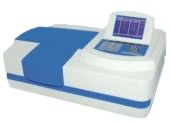 |
UV-Vis Double Beam Spectrophotometer LI-2902
Maximum of 9 wavelengths and 7 samples can be measured at one time.
Automatic change between lamps
Rich measurements method: wavelength scan ,multi-wavelength determination, multi-order derivate determination, double-wavelength method and triple-wavelength method etc. meet different measurement requirement.
Automatic10 mm 8 cells holder.
Data output via a printer port and a RS-232 interface.
PC controlled measurement can be achived for more accurate and flexible requirement.
Technical Specifications
- Wavelength Range:190-1100nm
- Spectral Bandwidth:1 nm
- Working Mode: T.A.C.E
- Optical System: Double Beam
- Scanning Speed: Fast/ Medium/ Slow
- Photometric Range: -0.3-3.5 A, 0 to 220% T
- Wavelength Accuracy: ± 0.3 nm
- Wavelength Reproductibility: <0.10 nm
- Photometric Accuracy: ± 0.3% T (0~0.1A) ± 0.002A (0~0.1A)
- Photometric Reproductibility: <0.15% T
- Stray Light: <0.1% T (Nal.220nm, NaNo2 340nm )
- Baseline Flatness: ± 0.002A
- Stability: <0.001A/h (at 500nm,after warming up)
- Noise: ± 0.001A (at 500nm,after warming up)
- Detector: Dual silicon photodiode
- Display: 6 inches high light blue LCD
- Power: AC 220 ± 10%,50 Hz
- Dimensions: 630 x 470 x 210 mm
- Weight: 26 kg
|
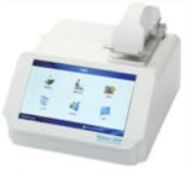 |
Micro-volume UV-Visible Spectrophotometer
It is a compact spectrophotmeter for very small volumes (DNA, protein measurement for exemple)
- Long life Xenon flash lamp
- Built in printer
- Wavelength range: 200 to 800 nm
- Wavelength accuracy: 1 nm
- Sample size: 0.5 to 2 uL
- Path length: 2 nm or 1 nm
- Absorbance range: 0 to 3 A
- Absorbance accuracy: 0.003 Abs
- Dimensions: 210 x 268 x 181 mm
- Weight: 3 kg
- Operating voltage: 24 V
- Power consumption: 40 W
|
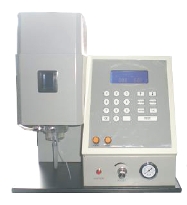 |
Flame Photometer AE-SFP
This instrument is used for analyzing and measuring the content and concentration of elements K, Na, Li, Ca, Ba.
Standard accessories: air-compressor, PC software or micro-printer.
Measurement Range: K: 0-100ppm; Na: 0-100ppm; Li: 0-100ppm; Ca: 0-1000ppm; Ba: 0-3000ppm
Measurement Limit: K: 0.01ppm; Na: 0.01ppm; Li: 0.025ppm; Ca: 0.1ppm; Ba: 10ppm
Drift < 3% (30 minutes after instrument stability)
Sample Rate 4 to 6ml/min
Response Time
Size & Weight 530X510X580mm & 27kg
|
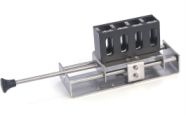 |
Acessories for spectrophotometer AES
4 cells cuvette holder, for 10 mm cuvette
4 cells cuvette holder, for 50 mm cuvette
4 cells cuvette holder, for 100 mm cuvette
8 cells cuvette holder, for 10 mm cuvette
10mm single hole water jacketed cuvette holder
Integrating Sphere
Test tube holder:
|
|
|